
Dry Air Supply for Transformer Assembly and Maintenance
Overview
Manage Moisture Exposure During Transformer Work
Opening a transformer for assembly, inspection, or repair can expose its internal parts to the surrounding air. Where the approved procedure calls for dry air, the supply must meet the required moisture level throughout the task.
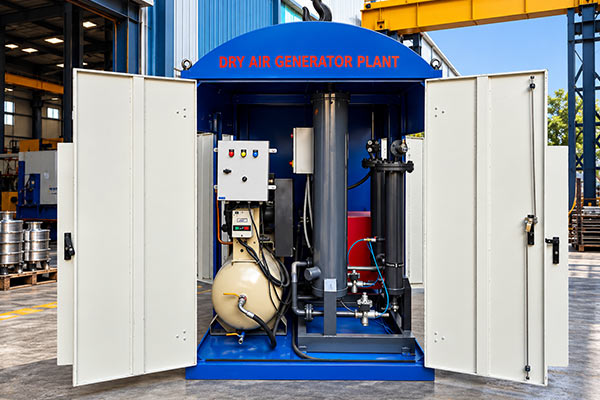
Tri Force Machinery’s Dry Air Generator Plant treats the incoming air through an arrangement selected for the application. Drying reduces water vapour, while the specified filtration components address particles and other contaminants within their rated capability.
The plant should be chosen according to the air needed at the point of use. A low dew point alone does not establish suitability. Delivered airflow, pressure, inlet temperature, and the condition of the connecting pipework also influence performance.
Establish the Air Requirement Before Selection
Outlet dew point | Delivered airflow | Working pressure | Inlet conditions
Dry Air Treatment Functions
Prepare the Air for Its Intended Use
A dry air plant brings together several treatment functions. The required combination depends on the incoming air and the quality expected at the outlet.
Water Vapour Removal
The desiccant section captures moisture from the air. This allows the system to reach lower dew points than a refrigerated dryer alone would normally provide.
Condensate Drainage
Automatic drain valves discharge collected liquid from the appropriate treatment stages. Effective drainage helps prevent that liquid from moving further through the system.
Particle Filtration
After-filters and ultra-fine filters remove particles within their specified ratings. Their selection should match the application’s air cleanliness requirements.
Additional Air Treatment
Tri Force Machinery lists a refrigeration air dryer and carbon filter among the available treatment components. Their inclusion and performance should be defined in the proposed plant configuration.
Technical Specifications
Dry Air Generator Plant Details
Tri Force Machinery published dew point needs to be confirmed against the selected model’s operating conditions. The quotation should identify whether the value is measured at operating pressure or atmospheric pressure, together with the measurement location.
Information Needed to Size the Plant
What Sets It Apart
Low Dew Point Drying Option
The heatless/desiccant range is listed for a dew point of −70°C or better. Buyers can specify the required value and request confirmation of the conditions under which it will be achieved.
Drying and Filtration Within One Arrangement
Moisture and particles need different treatment methods. The plant can bring the required drying and filtration stages together for the specified air supply.
Automatic Condensate Discharge
The listed automatic drain valve provides a means of removing collected liquid. Drain selection and servicing remain part of maintaining the air treatment system.
Models for Different Air Demands
Tri Force Machinery manufactures multiple air dryer plant models. The required outlet flow and inlet conditions provide the basis for selecting an appropriate size.
Practical Installation and Maintenance
The product is described as easy to install and low maintenance. Access for filter replacement, drain checks, and desiccant servicing should be included when planning its location.
Configuration for Transformer Applications
The plant is offered for transformer work. Customers can submit their assembly or maintenance requirements so the proposed air treatment arrangement can be reviewed against that procedure.
Working Principle
How a Desiccant Dry Air System Operates
A desiccant dryer removes water vapour through adsorption: moisture collects on the surface of the drying material. Regeneration removes that collected moisture so the material can be used again.
Heatless designs commonly use a portion of the dried compressed air for regeneration. This air consumption must be considered when calculating the supply available to the application.
Step 1
Receive the Incoming Air
The plant receives air within the specified inlet pressure, temperature, and flow limits.
Step 2
Remove Collected Liquid
The selected pretreatment and drainage arrangement separates and discharges liquid where required.
Step 3
Dry the Air Through Desiccant
Air passes through the drying section, where the desiccant captures water vapour.
Step 4
Regenerate the Drying Material
The regeneration cycle restores the desiccant’s capacity to collect moisture. The exact cycle follows the selected dryer design.
Step 5
Apply the Specified Filtration
The required filter stages remove particles or other contaminants according to their ratings. Their positions depend on the approved system arrangement.
Step 6
Deliver and Verify the Air
Treated air reaches the designated connection point. Dew point and other agreed checks confirm whether the supply meets the application requirement.
Applications
Where a Dry Air Generator Plant Can Be Used
Transformer Assembly
Dry air may be specified during assembly tasks where exposure to humid ambient air needs to be controlled.
Internal Inspection Work
Maintenance teams can assess the plant for procedures involving an opened transformer, following the equipment manufacturer’s instructions.
Transformer Repair Facilities
Repair workshops can specify a dry air supply around their servicing methods and the size of the equipment being handled.
Site Overhauling Projects
A plant can be considered where transformer work at a substation or industrial site requires a defined dry air source.
Other Moisture-Sensitive Air Applications
Additional uses require a separate review of pressure, cleanliness, and moisture limits. Suitability should follow the process specification.
Industries and Facilities
Air Treatment for Electrical Equipment Operations
Potential users include transformer manufacturers, transformer repair companies, electrical maintenance contractors, utilities, and industrial facilities carrying out transformer servicing.
The plant requirement follows the work being performed. Transformer dimensions, openings, task duration, and the approved procedure help determine the necessary airflow and air quality.
Benefits of a Specified Dry Air Supply
Limit Humidity Introduced During the Task
Using air with a defined moisture level helps teams manage exposure during procedures that require dry air.
Make Air Quality Measurable
An agreed dew point provides a numerical acceptance criterion. Measurements can be recorded rather than relying on the appearance or feel of the air.
Support Repeatable Maintenance Procedures
A specified air supply helps different teams carry out comparable work against the same operating requirements.
Address More Than Moisture Alone
A suitable filtration arrangement can manage particle contamination alongside air drying. Each treatment stage should have a clearly stated function.
Plan the Available Air Capacity
Accounting for regeneration demand helps establish how much treated air remains available at the outlet. This supports proper matching of the dryer and upstream air source.
Why Choose Tri Force Machinery
A Product Range Focused on Transformer Work
Tri Force Machinery supplies dry air plants alongside transformer oil filtration and evacuation equipment. Buyers can discuss the different equipment needed for their maintenance project.
Plant Selection Around Your Air Conditions
The team can review the requested airflow and dew point together with the available inlet supply. These details help establish a suitable configuration.
Customization Options
Tri Force Machinery product page describes customized solutions and multiple air dryer models. The proposed scope can identify the treatment stages and accessories included.
Quality Checks Before Delivery
Tri Force Machinery states that its air dryer products are checked for quality before delivery. Customers can request the inspection and performance checks required for their purchase.
Frequently Asked Questions
The plant reduces moisture in an air supply and applies the specified filtration. Triforce offers this equipment for transformer applications that require dry air.
Tri Force Machinery lists −70°C or better for its heatless/desiccant air dryers. Confirm the measurement basis, inlet conditions, and delivered airflow in the technical offer.
No. Dew point describes the air’s moisture condition at a stated pressure. It does not mean the air is delivered at −70°C.
No. Refrigerated dryers cool air to condense moisture. Desiccant dryers capture water vapour on a drying material and are used where lower dew points are required.
Heatless dryers commonly use part of the dried air to regenerate the desiccant. Request both the inlet air demand and usable outlet flow when comparing proposals.
A dry air supply and an insulation drying process serve different purposes. Use the transformer manufacturer’s procedure to determine the treatment needed for the equipment’s condition.
Price depends on airflow, pressure, required dew point, inlet conditions, treatment stages, instrumentation, and accessories. A defined operating requirement allows a more accurate quotation.
Request a Dry Air Generator Plant Quotation
Give Tri Force Machinery your required outlet flow, working pressure, target dew point, and expected operating duration. Include the details of your available air source and site electrical supply.
Request a proposal stating the delivered air capacity, regeneration demand, included filters, dew point measurement basis, and installation requirements. These details help your team compare the plant against the intended work.